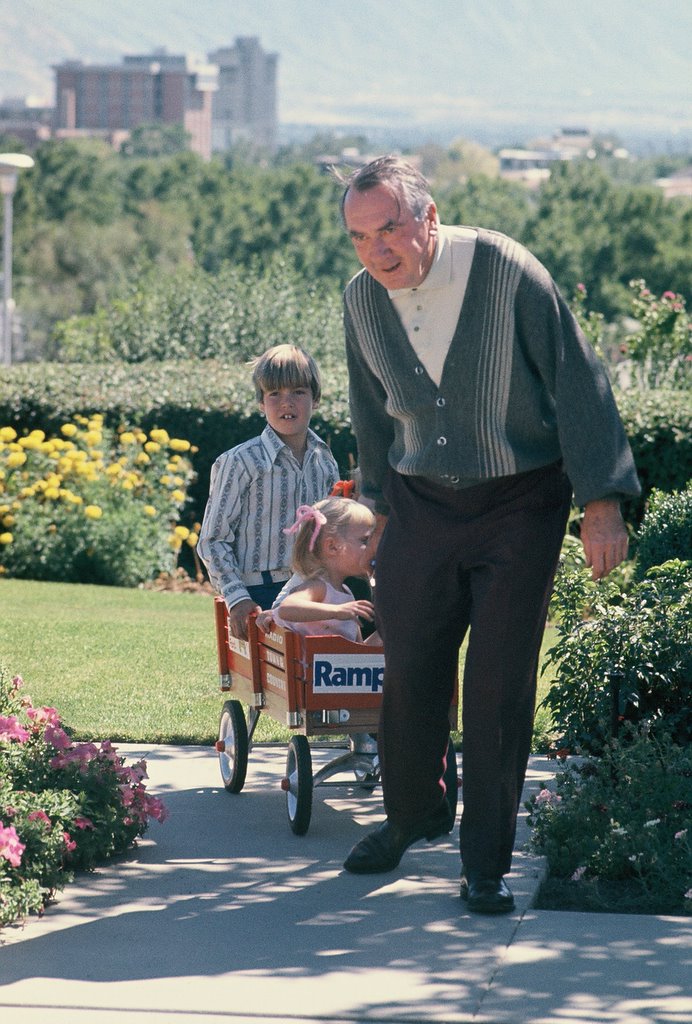
Showing posts with label Governor Calvin L. Rampton. Show all posts

Friday, September 21, 2007

SL Trib: Cal Rampton, beloved former governor, to be laid to rest today


Many paid respects at Governor's Mansion Thursday
By Robert Gehrke
The Salt Lake Tribune
Article Last Updated:09/21/2007 07:31:36 AM MDT

Scores of Utahns filed through the Governor's Mansion on Thursday to pay tribute to the late Cal Rampton, the state's longest serving governor.

"I think he wouldn't have expected it," said Rampton's daughter, Janet Warburton. "He was a pretty humble guy when it gets down to it, and he said, 'Nobody would come.' "

But scores of people did come, from old friends to passing acquaintances, to three classes of seventh-graders, all born nearly two decades after Rampton left office.

Rampton's flag-draped casket sat just inside the main south doors of the historic mansion, with an American flag and Utah National Guard soldier at one end, a Utah flag and state trooper at the other.

Rampton never lived in the current Governor's Mansion, which was turned over to the state Historical Society by his predecessor, J. Bracken Lee, but restored as the first family's residence by his successor, Scott Matheson.

Rob Miller, now vice-chairman of the Utah Democratic Party, spent much of his youth in the Utah Capitol while his father was Rampton's press secretary and later a senior aide, and said Rampton is the reason he's a Democrat today.

Miller said one afternoon he and his sister were fighting over a record player in the office next to his dad's when Rampton made peace between the feuding siblings and listened to records while he held the children on his lap.

"He was a true gentleman," said Gloria Hunt, who worked in the highway department during the Rampton administration and still works in the Governor's Office. "He had a real vision of what state government should be."

Many who came praised his willingness to work across party lines and find solutions that would benefit the state, particularly his efforts to improve Utah's education system and bolster tourism and economic development.

"He had a knack for bringing people together, all people, not just one group of people," said Joe Torres, a state employee. "That's why I stopped by today, because he had a knack for that and I think that's somewhat lacking today."

Brent Cameron was part of a body created by Rampton to foster industrial development, called "Rampton's Raiders," and later was his campaign coordinator in Salt Lake County when Rampton ran for a third term.

"Cal has always been a true inspiration and mentor to me and a true friend," Cameron said.
George Durham knew Rampton through his father, G. Homer Durham, whom Rampton appointed as the first commissioner of education and spoke highly of the governor.
"As I visited here a lot, I heard what a competent and capable man he was," Durham said.
Rick Olsen, a teacher at Bryant Middle School, brought three of his classes to the mansion because he believed it was a chance for them to see history.

"I want the kids to find out the importance, not only of our government, but what are the protocols of coming to a state ceremony," he said.

Richard Christenson was a teenager when he met Rampton, then an attorney in private practice, and said the future governor always treated him as a contemporary.

Years later, Christenson became Rampton's LDS Church bishop and home-teacher.
"Cal treated all human beings as if they were children of God," he said. "He didn't wear his religion openly. He just lived it."

As he aged, Rampton remained a lion in the Utah Democratic Party, frequently speaking at party gatherings and advising party leaders.

Party Chairman Wayne Holland said, "The Guv" serves as a model when he tries to recruit young candidates to run for office, both for his leadership ability and his perseverance, since Rampton ran and lost a half-dozen times.

Holland said he, Rampton and some other Democrats were meeting recently at The Alta Club, when one Democrat started griping about what they felt were dirty political attacks from Republicans, and asked when Democrats were going to respond in kind.

Rampton slammed his fist on the table and bellowed in his gruff voice: " 'Integrity! Integrity is what we're about,' " Holland said. " 'We may win or we may lose, but we'll never lose our integrity.' "

Rampton died Sunday at the age of 93. He had been diagnosed with cancer and suffered a stroke after entering hospice care. Despite his ailments, those who visited him in hospice said his renowned mind remained sharp.

Warburton said that, as the stream of friends visited him, "it was starting to dawn on him that he was loved."

Rampton's funeral will be at 11 a.m. today at the Salt Lake Parleys LDS Stake Center, 1870 E. Parleys Canyon Blvd.

Monday, September 17, 2007

News Release: Utah mourns a political visionary

SALT LAKE CITY - Calvin L. Rampton, a popular three-term Democratic governor of Utah, died Sunday night.

Gov. Rampton was first elected in 1964 and is the only Utah governor to serve three full terms. He was governor from 1965 to 1977.

A moderate Democrat and astute politician, he easily fit the centrist mold of Utah politics and was elected each time by overwhelming majorities. He probably could have won a fourth term. Instead, he returned to private law practice and hand-picked the Democratic candidate, Scott M. Matheson, to succeed him. Even though Utahns that year voted overwhelmingly for Republicans Gerald Ford for president and Orrin Hatch for U.S. senator, Matheson won.

“It’s hard to overstate the impact Gov. Rampton had on Utah,” said Wayne Holland, chair of the Utah Democratic Party. “He was a visionary and an effective governor whose legacy has made life better for all Utahns.”

Rampton was considered an underdog, perhaps even a sacrificial lamb in 1964, running against Republican Mitchell Melich. But Barry Goldwater and his brand of radical Republicanism led the GOP to defeat that year in Utah as well as in the rest of the nation. Once in office he became one of the most popular governors in the state’s history.

As a Democrat during the height of the Vietnam War, he had a knack for bringing people together. His pro-business/development philosophy allowed him to become the consensus candidate of Utah’s business and political establishment.

“The governor was adamantly outspoken against today’s style of slash and burn politics,” said Holland. “I remember one conversation I had with him recently. He made it crystal clear that the Democrats should campaign with integrity. Win or lose personal integrity should never be sacrificed.”

Gov. Rampton worked closely with business leaders and pushed industrial development, tourism, development of energy resources, and expansion of the defense industry in Utah. He also established the “Little Hoover Commission” to recommend ways of restructuring and reorganizing state government, established the Utah Police Training Academy, and created the Governor’s Conference on the Arts. While in office, he was chair of the National Governor’s Conference, 1974-75; president of the Council of State Governments, 1974-75; chair of the Western Governor’s Conference, 1969-70; and co-chair of the Four Corners Regional Commission, 1971.

According to a recent profile published by The Deseret Morning News, Gov. Rampton launched the state’s first Olympic bid, but he said he was relieved to see the proposal advance no further than U.S. Olympic Committee approval in 1973.

Since leaving office, Rampton practiced law in Salt Lake City.

“The values Cal embraced as governor are clear: moderation, persistence, collaboration, and an unwavering commitment to public service,” said Holland. “Frankly, I believe the greatest tribute we could provide Gov. Rampton is to acknowledge his life as an inspiration for politicians on both sides of the aisle.

“It’s important to remember that the governor was a consensus builder during a period of deep divisions in our country. We should be saying, ‘If Cal brought the parties together during Vietnam, we can and must do it now.’ ”

The former governor had been diagnosed with cancer and was living at CareSource hospice in Holladay since about July. His health had been declining since his wife, Lucybeth, died in 2004.

Funeral services will be held Friday at 11 a.m. at Parley’s LDS Stake Center, 1870 E. Parley's Canyon Blvd. (2200 South). A viewing will be held Thursday from 6-8 p.m. at Larkin Mortuary, 260 E. South Temple.


Calvin L. Rampton

Born: Nov. 6, 1913, in Bountiful, Utah, to Lewllyn S. Rampton and Janet Campbell Rampton.
Married: Lucybeth Cardon, March 10, 1940
Died: Sept. 16, 2007
Survivors: Daughter, Janet Warburton; sons Anthony Rampton, Vincent Rampton, all of Salt Lake City; numerous grandchildren, great grandchildren, brother Byron, sister Virginia. Preceded in death by parents, wife Lucybeth and daughter Meg.

Highlights as governor

  • Utah’s eleventh governor, serving three terms from 1965 to 1977;
  • Established the Industrial Promotion Council and the Travel Council in order to promote industrial and recreational opportunities in Utah;
  • Developed the Commission on the Organization of the Executive Branch of the Government (“Little Hoover Commission”) to consolidate and streamline Utah state government operations;
  • Expanded state building program that anticipated the demands placed upon higher education institutions by a rapidly maturing boomer population;
  • Initiated civil rights legislation with state bills that complied with the federal Public Accommodations Act and the Fair Employment Practice Act.


Timeline

  • Rampton was born on Nov. 6, 1913, in Bountiful, Utah, the eldest of three children of Lewellyn Smith Rampton and Janet Campbell Rampton.
  • Rampton took over the family automobile business, due to his father’s death that same year, following his graduation from Davis High School in 1931. He sold the business in 1933 and entered George Washington University Law School and University of Utah. While in Washington, D.C., Rampton was an administrative assistant to Utah Congressman J. Will Robinson. He graduated from the University of Utah with a law degree in 1940.
  • Rampton married Lucybeth Cardon on March 10, 1940. They had four children.
  • Rampton was Davis County Attorney and Assistant Attorney General for Utah after graduating from law school.
  • Rampton served in the U.S. Army in Europe during World War II and was Chief of the Senior U.S. Army Claims Commission in Paris at the end of war.
  • Rampton returned to Salt Lake City after the war and practiced law until his election as governor in 1964. During this period, he became an authority on transportation and taxation law and developed a wide range of political and corporate ties.
Recent quotations
“Cal was an important and wise adviser for the Utah Democratic Party and Democratic candidates, even to the end. His counsel focused not only on what was good for the party, but more importantly what was important to the state as a whole.”
Wayne Holland, chair, Democratic Party of Utah.
“The governor was always in tune with what was happening, Utah issues certainly, but also technical issues at the national and international level.”
Wayne Holland, chair, Democratic Party of Utah.
“In my personal discussions with him, whether it was in his apartment in Holladay or at the Alta Club with his old and new friends, he was always quick to cut to the chase and articulate a common sense resolution to issues that seems to evade today’s spin masters.”
Wayne Holland, chair, Democratic Party of Utah

“Governor Rampton was that rare public leader who could see both the forest and the trees. He provided great strategic vision on issues like education and economic development. At the same time, his detailed mastery of the state's budget and his knowledge of every community in the state were extraordinary. These qualities combined with his progressive leadership make him Utah’s first truly modern Governor. He has been the model for all of his successors.”
Scott Matheson, former dean, University of Utah Law School


“Cal’s life was a testament to the underdog. He lost election after election but stayed in the game only to become one of Utah’s most influential governors and leaders. His ability to break through partisan barriers for the common good of all Utahns is an example we should all examine and remember."

Rob Miller, vice chair, Democratic Party of Utah


“Cal Rampton brought an intelligence and integrity to the political landscape that everyone respected. When he spoke, everyone knew that he had thought long and hard about what he was going to say. He never said something just to get headlines. And when he made a decision, there was no question that he believed it was the best decision for the state, not for political expediency or a vested economic interest.”

Pat Shea, former chair of the Utah Democrat Party


“Cal Rampton was an unsurpassed leader, one whose foresight, intellect and humor has paved the way for Utah’s modern era.”

Ralph Becker, minority leader in the Utah House of Representatives


“Cal Rampton’s leadership and commitment to the Democratic Party in Utah was remarkable and will be long remembered.”

Jenny Wilson, Salt Lake County Council


“I think we all see Cal as the father of modern economic development in the state of Utah. He reorganized government. He supercharged government/business development. And he launched serious the serious promotion of tourism. What he did has reverberated for 30 years and continues to influence the way government does business.”

Mickey Gallivan, former Utah travel director


“Gov. Rampton set the benchmark for modern-day governors. His leadership and service brought enormous success and pride to the people of Utah. We all are beneficiaries of his legacy. Mary Kaye and I express our heartfelt condolences to the Rampton family. The entire State of Utah joins them in mourning the loss of one of the finest public servants we have ever known.”

Jon Huntsman Jr., current governor of Utah

SL Trib: Cal Rampton: Former three-term governor dies at 93


Cancer claims popular Democrat
Cal Rampton: Former three-term governor dies at 93
By Paul Rolly
The Salt Lake Tribune
Article Last Updated:09/17/2007 10:23:58 AM MDT

Calvin L. Rampton lost six elections in a row and seemed to be Utah's consummate political loser before he was elected governor in 1964, served three terms and earned a place in history as one of the state's most significant figures.

He died Sunday night of cancer in a Holladay hospice. He was 93.

Rampton modernized state government, invented Utah's economic and tourism development model and renovated and expanded college and university campuses in preparation for the onslaught of baby boomer students.

He is remembered not only for his accomplishments as a government leader, but for a steadfast integrity and honesty viewed by many as uncommon in today's political environment. And he is known for the endearing partnership he had with his wife, Lucybeth, whom he honored both in his speeches and writings as a guiding force in his life.

"Cal Rampton brought an intelligence and integrity to the political landscape that everyone respected," said Pat Shea, former chairman of the Utah Democrat Party and a one-time gubernatorial candidate.

"When he spoke, everyone knew that he had thought long and hard about what he was going to say. He never said something just to get headlines," Shea said. "And when he made a decision, there was no question that he believed it was the best decision for the state, not for political expediency or a vested economic interest."

Elected in 1964, Rampton broke a 16-year Republican grip on Utah's statehouse and secured a Democratic stronghold that would last through his 12 years in office and another eight years under the late Scott Matheson, whom Rampton mentored and helped get elected in 1976.

Rampton said in a recent interview that he became a Democrat "at the knee of my maternal grandfather, who would hold me on his lap and tell me the virtues of low tariffs over high tariffs. I had no idea what he was talking about, but I knew I loved it."

His attraction to the party that would eventually honor him as its greatest leader was enhanced by the influence of his Davis High School debate teacher, Frank Muir, who taught him to speak directly to his audience by flinging pieces of chalk at his forehead every time he looked away.

"Although my maternal grandfather already had me steered toward being a Democrat, if there was any doubt about it, Frank Muir put the finishing touches on it," Rampton wrote in his 1989 memoir, As I Recall.

After he was elected as the part-time Davis County attorney in 1938, Rampton lost bids for the state Senate in 1940, 1948 and 1952, as well as bids for state Democratic party chairman and Democratic national committeeman during the 1950s. He tried for the U.S. Senate in 1962 and lost in the Democratic primary.

But he never could stay far from the political fray. His political activity began when he was in his 20s as an aide to Rep. Will Robinson, D-Utah, in Washington, D.C., where he met Lucybeth Cardon, a legal secretary.

He married her in 1940 after earning his law degree at the University of Utah even as he served as Davis County attorney and ran Robinson's Utah field office.

Rampton's law and political career, as well as his family life, were interrupted when the United States entered World War II and Rampton was activated by the Army as a second lieutenant. He worked mostly for the Judge Advocates Office, but eventually went to France, the scene of this memorable story:

"There was a small airfield near Beauvais, and as the Battle of the Bulge was winding down after Christmas the Germans . . . dropped a great number of parachutists around the area. Therefore, we all had to answer with passwords at the various checkpoints. An army sentry stopped me at a checkpoint and asked me for the password, but I couldn't remember it. He brought his gun up and said, 'What's Blondie's husband's name.' I told him I couldn't remember his name, but that he eats those big sandwiches. The sentry laughed and let me pass."

In France he also ran into his childhood friend Max Rich, who later would be one of his most trusted advisers when he was governor. Rich was leading a battalion toward the Battle of the Bulge, but took time to visit Rampton's quarters "where we drank champagne and sang old Davis High School songs."

After the war, Rampton worked as an assistant Utah attorney general and in a private law firm with two other attorneys. His family grew to six, with four children born between 1941 and 1952, and he remained active in state and national Democratic politics.

During his run for the governorship, Rampton had the help of a group of advisers his wife dubbed "the back-yard mafia," who'd sit around his swimming pool and devise strategies. After a particular vicious attack against Rampton in fliers distributed by an anonymous group a week before the 1964 election, some of his advisors wanted to respond in kind.

Rampton considered it, but said his son Tony "was aghast that I would even think of such a thing."

In the end, his campaign did not go negative. "And I'm glad we didn't do it," he wrote.

The "back-yard mafia," consisting mostly of fellow attorneys active in the Democratic party, stuck with him after he was elected. They gathered a group of about 30 "bright young Democrats" who met with Rampton every evening to build an agenda. He credited that group for his ability to get most of what he wanted through his first Legislature, which was predominantly Democratic, in 1965.

After his three terms, Rampton resumed his private law practice where he worked mostly in corporate law. He continued to work at the law firm of Jones, Waldo, Holbrook and McDonough - except for Fridays, his golf day - well into his 80s.

He also continued to hold court as a valued political mentor for a new generation of Democrats. Even in his late 80s, he was the keynote speaker at a Democratic state convention, where he referred to Utah's all-Republican U.S. House delegation as "the three stooges."

The closest thing to a scandal in Rampton's administration involved allegations that the Utah Liquor Commission improperly used its inventories of alcohol for personal use. One commissioner was indicted, but was acquitted at trial.

"When a reporter confronted Rampton at his monthly televised news conference, stating, "Isn't it true you improperly served alcohol at the Governor's Mansion?" Rampton replied: "Yep. It won't happen again."

"Rampton proved that even if there is a potential scandal, there is a window of escape if you are honest," Shea said. "You see politicians today, even when they are innocent, go through these lawyer-like contortions to get out of something that looks embarrassing. They've lost the Rampton rotor of integrity."

Rampton's blunt honesty and the compassion he and his wife Lucybeth exhibited endeared him most to his acquaintances and constituents both during and after his tenure in office.

Matheson used to tell this story: Jimmy Carter, who had been the governor of Georgia, was running for president. Asked what he thought of Carter, Rampton replied that he was one of the five worst governors he had served with.

The quote went on the national news wire and Carter heard about it. He called Rampton and said: "Cal, did you really say that about me?"

After a pause, Rampton said, "Yes, Jimmy, I did. But I didn't know reporters were there."
-----------------------
Calvin L. Rampton:
Born: Nov. 6, 1913 in Bountiful, Utah to Lewllyn S. Rampton and Janet Campbell Rampton.

Married: Lucybeth Cardon March 10, 1940:
Died: Sept. 16, 2007
Survivors: Daughter, Janet Warburton, Sons Anthony Rampton, Vincent Rampton, all Salt Lake City. Numerous grandchildren, great grandchildren. Brother Byron, sister Virginia? Preceded in death by parents, wife Lucybeth and daughter Meg.

Funeral: arrangements pending.